Guide
What is a PSA adhesive, and how is it used in footwear?
PSA stands for pressure-sensitive adhesive — the kind of adhesive you find on self-adhesive tape. It arrives ready to use and bonds with nothing more than pressure. In footwear and leather goods, that means bonding without solvents, without heat and without waiting.
Published · 4 min read
What a pressure-sensitive adhesive is
A pressure-sensitive adhesive stays tacky in its dry form and bonds when pressed against a surface. It doesn't need water, solvent or heat to activate. That's exactly how Kyotex describes its K System line: solid, cold adhesives activated by pressure.
The difference from liquid cement is fundamental. With solvent-based cement, the adhesive layer forms on your floor as the solvent evaporates. With a PSA, the adhesive film is already formed; on the line, you just place it and press.
Think of a can of contact cement next to a roll of double-sided tape: both bond, but only one needs drying time and a brush.
How the bond forms
Under pressure, the adhesive flows into the small irregularities of the surface until it makes close contact. Three things matter:
- Pressure: firm, even pressure improves contact.
- Surface: it has to be clean and dry; dust, oil and moisture reduce adhesion.
- Time: with many PSAs, the bond keeps building strength for a while after it's applied.
How it's supplied
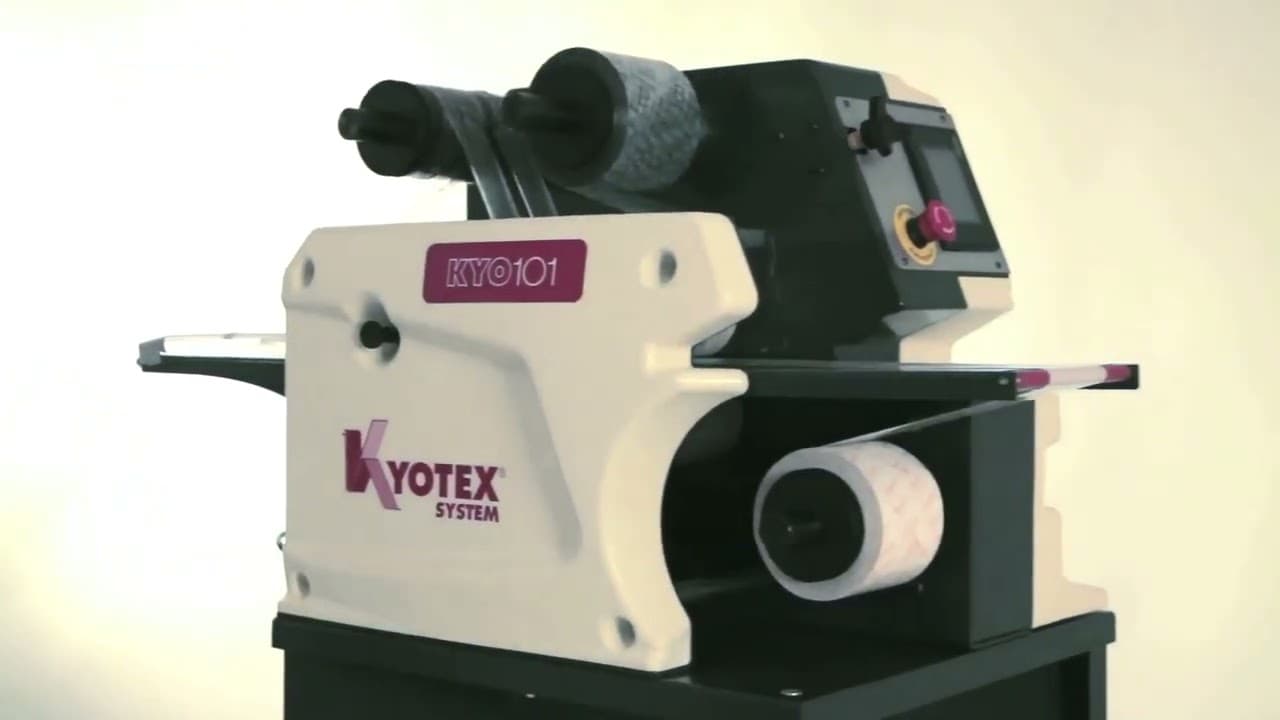
Across industries, PSAs usually come on tape, protected by a release paper or film that's peeled off just before bonding. Kyotex supplies its PSA adhesives on tape and applies them with its own machinery; on the equipment you'll see the rolls loaded and, for insole bonding, tape printed with the outline of each insole.
On a roll, the adhesive is already metered: every inch of tape carries the same coating, which helps keep bonding consistent from pair to pair.
How it's used in footwear and leather goods
Insole bonding
This is the best-known use. Insole adhesive tape is applied to the insole material, and at the bonding station the operator places the insole and presses. Kyotex calls it clean, immediate insole bonding: no ovens, no open flames and no solvent flash-off. More in solvent-free insole bonding.
Leather goods
In leather goods, PSAs let you join parts without applying liquid adhesive. Kyotex has a dedicated machine, the KYO500, for applying medium and large PSA adhesives in leather goods, and in 2025 ALC introduced new equipment for applying adhesive to zippers. See leather goods adhesives.
Prep work off the line
Because the adhesive is already formed, tape can be applied at one stage and the bond made later. That lets you prepare parts off the production line and leave only the place-and-press step on the line itself. It also makes planning easier: parts can be prepped in batches when the schedule allows.
Machinery for applying PSA
To lay tape down evenly and at production speed, Kyotex uses Kyo equipment designed together with the adhesive:
- KYO100S: pneumatic, for self-aligning application of PSA adhesives up to 145 mm (about 5.7 in) wide.
- KYO101: electronically controlled, for self-aligning application of PSA adhesives up to 145 mm (about 5.7 in) wide.
- KYO500: for medium and large PSA adhesives in leather goods.
See the full lineup on our shoe machinery page.
Fitting PSA tape into your line
- Decide where the tape gets applied. It can be in a prep area or right on the line; what matters is that it's a fixed step in the process.
- Apply it by machine. Equipment such as the KYO100S or KYO101 lays the tape down aligned and with even pressure.
- Protect prepared parts. While they wait, keep them clean with the liner on.
- At the station, peel, place and press. That's the entire bonding step.
- Check adhesion. Run your quality team's usual tests.
Strengths and limits
ALC describes tape-based bonding as a way to bring production concepts built on efficiency, environmental sustainability and respect for workers' health into footwear and leather goods. In practice, the clearest advantages are:
- No solvent to flash off and no open time.
- No heat, so it works for temperature-sensitive materials.
- An immediate bond on pressing.
- Less cleanup: no brushes and no pots of cement.
- Consistency: the amount of adhesive is set by the tape, not by an operator's brush.
There are limits worth testing for:
- Some surfaces, such as certain plastics or materials with special finishes, are harder to bond.
- The bond depends on applying enough pressure, evenly.
- Every adhesive has a service temperature range and storage conditions to respect.
When you need a structural bond without heat, Kyotex also offers K Next.
Common questions about PSAs
Is the bond permanent?
It depends on the formula: some pressure-sensitive adhesives are permanent and others are designed to be removable. For footwear, the formula is chosen for what the part has to withstand, and confirmed by testing.
Does it work on leather?
Yes. Kyotex uses PSA adhesives in leather goods, including medium and large parts with the KYO500.
Do I need to buy machinery?
At production volumes, an application machine helps keep the tape even and aligned on every part. A specialist can recommend equipment for your volume.
PSA, hot melt or solvent cement at a glance
- PSA: solid, cold, bonds with pressure.
- Hot melt: solid, bonds with heat and pressure (K Thermo).
- Solvent-based cement: liquid, bonds once the solvent flashes off.
To decide which fits, read how to remove solvents from insole bonding or request a quote — a Kyotex specialist will help you choose the tape and the equipment.