Guide
How to remove solvents from insole bonding
Insole bonding is one of the most repeated operations in a footwear plant — and when it runs on solvent-based cement, one of the biggest sources of fumes on the floor. This guide covers the alternatives, how to choose between them and how to make the switch without slowing production.
Published · 5 min read
What solvent-based insole bonding really costs
In the conventional process, operators brush, roll or spray shoe cement onto the insole, inside the shoe, or both. The cement is a polymer dissolved in organic solvents, so the parts can't be joined until most of that solvent flashes off. Only then is the insole placed and pressed.
That routine carries costs that rarely show up on the production sheet:
- Fumes on the floor. What flashes off are volatile organic compounds (VOCs) that operators breathe and that leave the building through your exhaust.
- Fire risk. Most of these solvents are flammable, so storage and application areas need special precautions.
- Flash-off time. Every pair waits for the cement to be ready.
- Cleanup and waste. Brushes, pots and equipment get cleaned with more solvent, and cement that skins over in the container is thrown away.
There's a compliance side too. In the United States, OSHA sets workplace exposure limits for many common solvents, and VOC emissions fall under federal, state and local air-quality rules; in Canada, federal and provincial rules apply. Taking solvent out of insole bonding addresses all of this at once — and because it happens on every pair, the change shows up across the whole line.
Three solvent-free alternatives
There are three ways to bond insoles without flashing off solvent, and Kyotex works with all three.
Pressure-sensitive insole adhesive tape
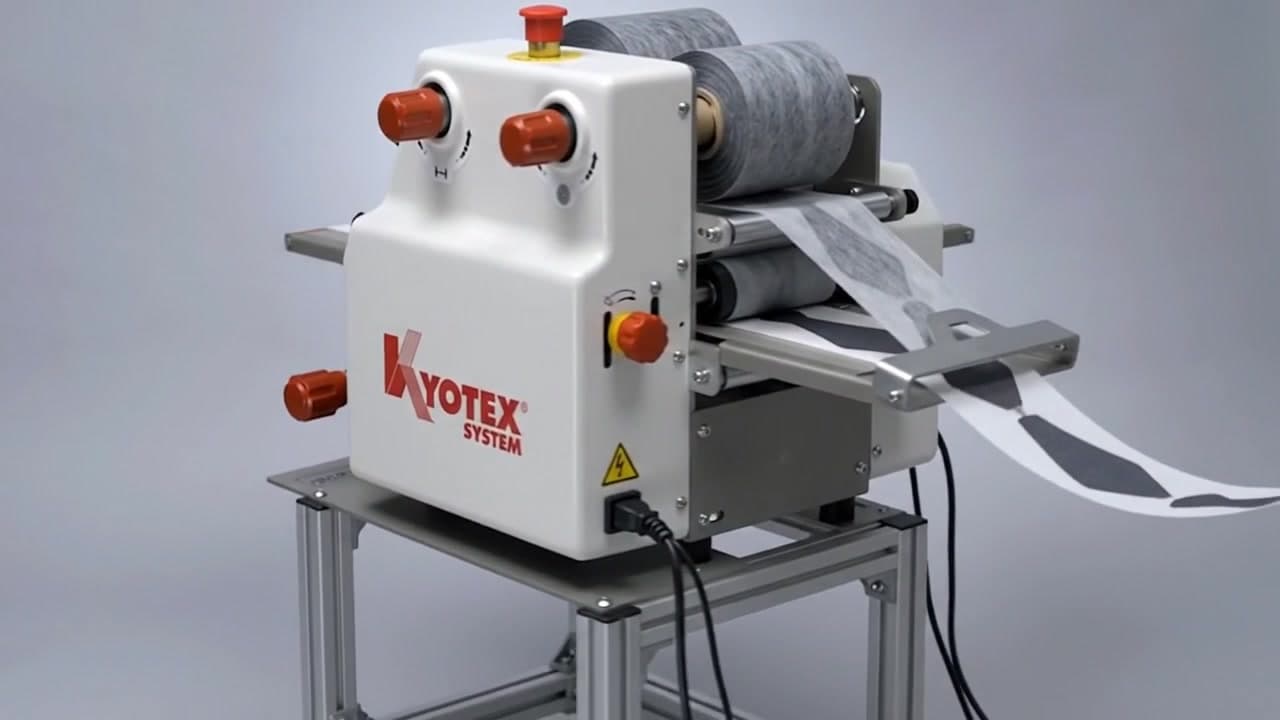
A pressure-sensitive adhesive (PSA) arrives as a solid, usually on tape, and bonds when pressed. The K System line is made up of solid, cold adhesives that activate under pressure. The tape is applied to the material with machines such as the KYO100S or KYO101, which handle widths up to 145 mm (about 5.7 in); at the bonding station, operators simply place the part and press. It's clean, immediate insole bonding: no ovens, no open flames and no solvent flash-off.
Hot melt adhesive
A hot melt is a thermoplastic polymer that melts with heat, is pressed and sets as it cools. K Thermo hot melts come as granules, powder, film, web and net. According to Kyotex, insole bonding is where powder hot melts perform at their best. You need a heat and pressure source, but there's no solvent to evaporate.
Cold bonding with structural strength
Some materials need a strong bond but can't take heat. That's what K Next is for: the bond strength of a hot melt without heating the part. ALC introduced it as a polyurethane-based adhesive tape for structural bonding.
How to choose between them
Before you request samples, work through these questions with your production team:
- What are you bonding? Note the insole material and the surface it goes onto: textile, board, foam, leather or synthetics.
- Can those materials take heat? If anything might warp, shrink or mark at temperature, rule out hot melt and compare PSA tape with K Next.
- How strong does the bond need to be? A comfort sock liner doesn't need the same bond as a part that has to survive daily wear.
- What equipment do you have? Heated presses already on the floor make hot melt attractive. Without them, PSA tape avoids adding heat equipment.
- What's your volume? It determines the application machine and how adhesive is supplied to the line.
With those answers, a specialist can suggest one or two options to test. For a deeper side-by-side, read hot melt vs. solvent-based shoe adhesive.
Making the switch, step by step
- Pick a pilot style. Start with a high-volume style and familiar materials, not your most difficult product.
- Agree on how you'll judge it. Settle with quality which adhesion tests and visual checks you'll use to compare against the current process.
- Test on the line, not just in the lab. Run a short production with your regular operators and log cycle times, rejects and feedback.
- Dial in the equipment. Pressure, tape alignment or temperature — depending on the technology — get calibrated to your line. Kyotex designs the machine and the adhesive together to make that easier.
- Train and document. Write up the new work instruction, including adhesive storage, and train every shift.
- Scale in stages. Move the remaining styles over once the pilot is stable.
What to measure
The simplest metric is already in your purchasing records: pounds or gallons of solvent-based cement bought each month. If insole bonding stops using it, that number drops. Other useful indicators:
- Cycle time per pair at the insole station.
- Rejects for delamination or cement stains.
- Cleaning solvent consumption.
- Operator feedback on odor and working conditions.
If your plant tracks emissions or runs exposure monitoring, compare results before and after the change. For a plant-wide plan, see how to reduce VOC emissions in a shoe factory.
Common mistakes
- Switching everything at once. A well-run pilot saves you problems across the line.
- Testing on dirty surfaces. Dust, oil and moisture hurt any adhesive; check part cleanliness before judging results.
- Ignoring storage. Every adhesive has its own storage conditions; follow the manufacturer's instructions.
- Judging only in the first hour. Some bonds keep building strength over time; also test after the dwell time your quality team specifies.
- Leaving operators out. They're the first to notice whether a station is easier or slower, so involve them from the pilot on.
Next steps
See our solvent-free insole bonding options, look at Kyo shoe machinery or request a quote. Kyotex-Terlan North America works with footwear manufacturers in the US, Canada and Mexico.