Guide
How to choose a footwear adhesive by material
An adhesive that performs well on leather can fail on a foam or a synthetic. So before choosing between pressure-sensitive tape, hot melt or cold bonding, you need to understand the materials you're joining. This guide walks through the most common materials in footwear, what to check in each and which solvent-free technology is worth testing.
Published · 5 min read
Why the material matters so much
Bonds form at the surface. For an adhesive to work, it has to make close contact with both materials it joins. A porous surface soaks up some of the adhesive; a very smooth or finished surface gives it less to grip; and dust, oil or residue from other products means the adhesive bonds to that layer instead of the material.
That's why there's no universal footwear adhesive — only adhesive-and-material combinations that work, and others to avoid.
Four questions for any material
- Is it porous or closed? Leather, textiles and boards absorb some adhesive; plastics and smooth finishes don't.
- Can it take heat? If it warps, shrinks or marks at temperature, rule out hot melt for that bond.
- How flexible does the bond need to be? Areas that flex when walking need a bond that moves with them.
- Are there finishes, oils or additives on the surface? Anything between the adhesive and the material reduces adhesion.
Those answers already rule some options out. Whatever is left gets confirmed with a trial on your line.
Before you start, ask your material suppliers for their technical data — heat tolerance, finishes and any adhesive recommendations. Having that on hand speeds up the trials.
Leather
Leather is porous and often carries surface finishes that can get in the way of adhesion, so some processes prep the bonding area first. Leathers with very closed finishes or heavy fatliquoring behave differently from more natural ones — if you switch leather suppliers, run the trial again.
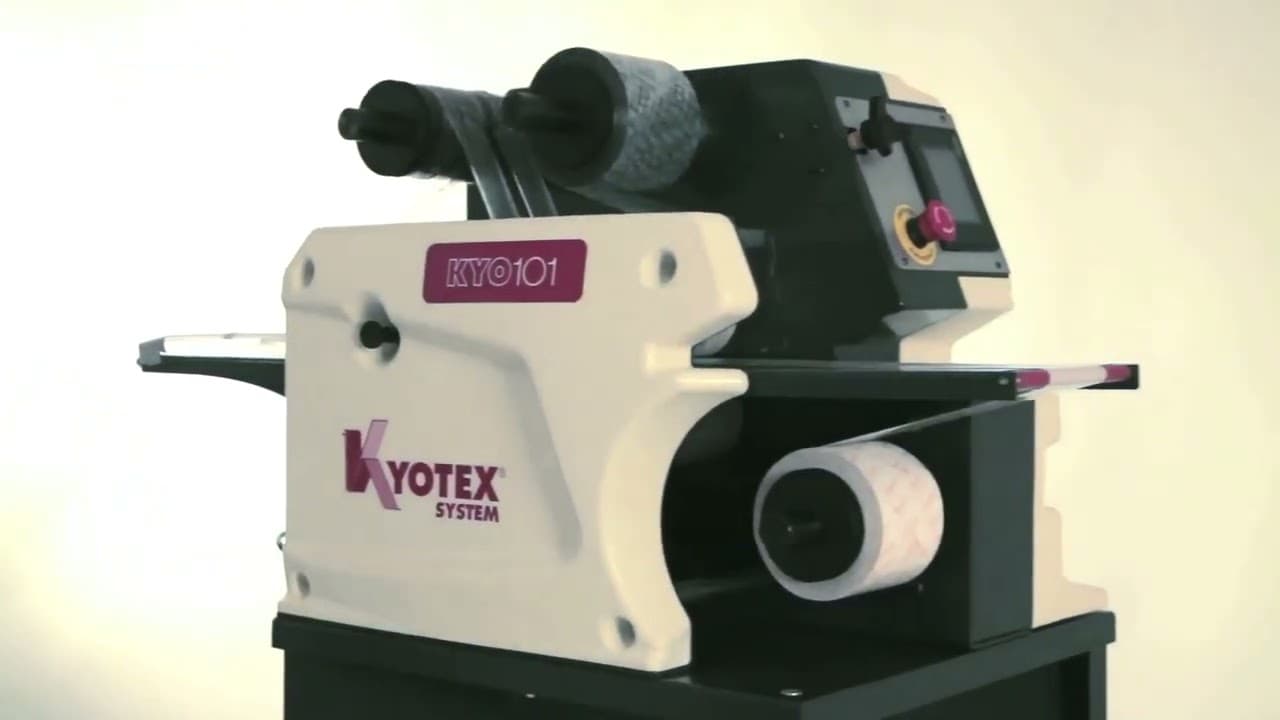
For leather, Kyotex works with K System pressure-sensitive tapes — in leather goods, with equipment such as the KYO500 for medium and large parts — and with K Thermo hot melts. Kyotex lists bonding PVC to leather among the uses of its powders, and EVA powder is used in large volumes in leather and footwear.
Synthetics: PU and PVC
Synthetics have more closed surfaces than leather, and their heat tolerance varies widely from one to the next. In some flexible PVCs, plasticizers can migrate to the surface over time and weaken the bond, so test the adhesive and check the bond again after a rest period.
If the synthetic can handle the activation temperature, a hot melt is an option. If not, look at pressure-sensitive tape or K Next, which delivers hot melt strength without heat.
Textiles and linings
Textiles are porous and flexible, and they're often laminated before cutting. That's done with hot melt film, web, net or powder spread across the fabric and activated with heat and pressure. Learn more on our lamination page.
If the fabric stretches, the bond has to stretch with it. Kyotex lists lingerie and stretch fabrics among the uses of its powder range; to compare polymers, read types of hot melt adhesive for footwear.
Foams
Insole and padding foams can flatten, shrink or deform with heat. If a foam can't take a hot melt's activation temperature, go with cold bonding: K System pressure-sensitive tape or, when you need structural strength, K Next. Open-cell foams can also soak up some adhesive, so check coverage.
Read cold insole bonding: what it is and when to use it to see how a heat-free station works.
Insole boards and fiber materials
Insole boards and fiber materials are porous and firm. To bond them without solvents, plants use pressure-sensitive tape and powder hot melt, which according to Kyotex performs at its best in insole bonding. Read what insole bonding is and how it's done.
Reinforcements
K Pads toe puffs, counters and microfibers come treated with Kyotex adhesives, hot or cold, so they fit into a solvent-free process. Read toe puffs and heel counters.
Common pairings in footwear
In practice you're rarely bonding a single material — you're bonding two different ones. A few common pairings and what to check:
- Sock liner onto insole board: the liner's foam or textile sets the rules; if it can't take heat, choose cold bonding.
- Textile lining onto leather or synthetic: hot melt lamination is common; make sure the bond stays flexible.
- Reinforcement between upper and lining: make sure activation doesn't damage the upper or the lining.
- Leather goods parts: pressure-sensitive tape avoids liquid cement, and the KYO500 handles medium and large parts.
Quick reference
- Leather: PSA tape or hot melt; check the finish.
- Synthetics: hot melt if they take heat; otherwise PSA tape or K Next. Test after a rest period too.
- Textiles and linings: hot melt film, web, net or powder.
- Foams: cold bonding if they can't take heat.
- Insole boards and fibers: PSA tape or powder hot melt.
- Reinforcements: K Pads, pre-treated with adhesive.
When you're joining two different materials, the adhesive has to work with both — the more delicate one decides.
Common mistakes
- Testing on one material and producing on another. A new supplier or finish can change the result.
- Ignoring moisture. A damp material, or one stored somewhere humid, won't behave like a dry one.
- Checking only right away. Some bonds change as they rest; evaluate again later.
- Choosing the adhesive before the process. First decide whether your line can use heat, then pick the technology.
- Leaving the line out. Operators are the first to notice when a material change makes a station harder.
Confirming the choice
- Test with the same materials and the same style you produce.
- Use your quality team's adhesion tests.
- Evaluate after the rest period too and, where it applies, after flexing the part.
- Log the results for each material combination so you don't repeat trials.
Once you've identified your materials, request a quote and a Kyotex specialist will help you choose the system. You can also browse all Kyotex systems.